
How Deep Can Mini Piles Go?
One of the most common questions when considering mini piling is how deep the piles need to be. The depth of a pile is a critical factor in ensuring that a structure is safely supported and that loads are transferred to stable ground. Mini piling is widely used for domestic and commercial projects across the UK, particularly where ground conditions are poor or access is restricted. In this guide, we explain how deep mini piles can go, what determines their depth, and why correct design is essential.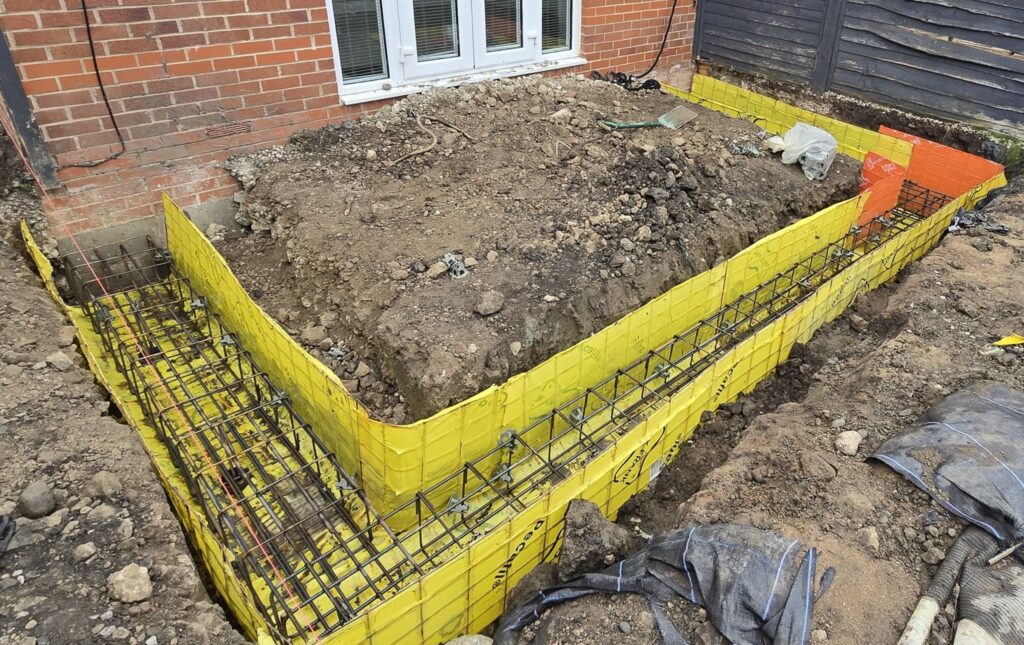
Typical Depth of Mini Piles
Mini piles can typically be installed to depths ranging from 5 metres to over 25 metres, depending on site conditions and structural requirements.
In many domestic projects, piles are often installed between:
- 8–15 metres for house extensions
- 10–20 metres for larger residential structures
- 15–25+ metres for commercial projects
However, there is no fixed depth for mini piles. The required depth depends entirely on the ground conditions and the load the pile must support.
What Determines Mini Pile Depth?
Ground Conditions
The most important factor affecting pile depth is the type of soil on site. Piles must extend through weak or unstable ground until they reach a strong, load-bearing layer.
Common scenarios include:
- Soft clay requiring deeper piles
- Made ground needing piles to bypass fill layers
- Dense granular soils allowing shallower depths
- Rock layers providing a strong bearing stratum
Where ground conditions are particularly challenging, systems such as overburden drill and case piles may be used to achieve the required depth.
Structural Load
The weight of the structure also determines how deep piles need to go. Heavier loads require deeper or more robust piles to safely transfer forces into the ground.
For example:
- Single-storey extensions may require shallower piles
- Multi-storey buildings require deeper foundations
- Commercial structures often demand greater pile depth and capacity
Type of Piling Method
Different piling systems can achieve different depths depending on the equipment and installation technique.
- Bottom driven steel cased piles are commonly used for restricted access and can achieve significant depths
- Sectional flight auger piles are suitable for a wide range of soil conditions
- Continuous flight auger piles can achieve greater depths efficiently
Site Constraints
Access restrictions and headroom limitations can also influence the type of rig used and, in some cases, the achievable depth.
However, modern mini piling equipment is capable of installing deep piles even in confined environments.
Why Do Piles Need to Go Deep?
The purpose of piling is to transfer structural loads to stable ground. Shallow soils are often too weak or variable to support a building safely.
By installing piles to sufficient depth, engineers can:
- Avoid settlement issues
- Improve load distribution
- Ensure long-term structural stability
- Prevent movement in weak soils
How Is the Required Depth Determined?
Before piling begins, a site investigation is typically carried out to understand the ground conditions. This information is used by engineers to design the foundation system.
The process includes:
- Soil testing and borehole data
- Structural load calculations
- Pile design and specification
This ensures that piles are installed to the correct depth for the specific site conditions.
Mini Piling Solutions from Dawson Foundation Engineering
At Dawson Foundation Engineering, we provide mini piling solutions tailored to the specific requirements of each project. Our team assesses ground conditions and structural loads to determine the optimal pile depth and installation method.
If you need advice on piling depth for your project, contact our team for expert guidance.