
ODEX piles
- Free site visits
- Free, transparent, no obligation quotes
- 48 hour response time
- Cost effective designs by our in-house chartered engineer.
- Short notice projects can be catered for.
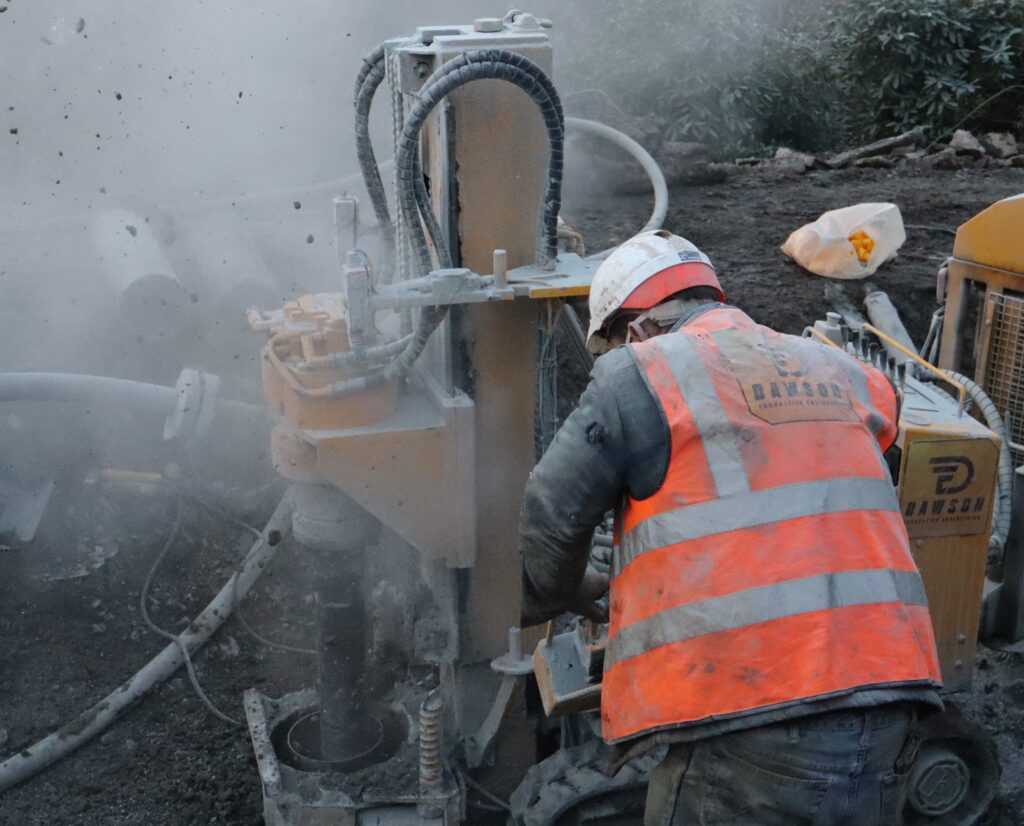
Overburden drill and case piling – also known as ODEX piling – is a twin-phase piling method used to install piles through overburden soils into rock. The first phase installs a thin-wall casing through the overburden soils to reach the rockhead; the second creates a socket into the rock itself. It’s often used where a driven or auger pile would refuse, such as through cobbles, boulders or dense granular ground, and is well suited to restricted-access projects where a large rig can’t be mobilised.
- Advantages
- Allows piles to be constructed in the most challenging of ground conditions.
- Allows piles to be founded below coal seams or cavities.
- Ideal for restricted access/headroom projects where substantial pile loads are required.
- Piles can be installed through boulders and unreinforced concrete.
Pile Sizes Available
Pile diameters are known by their casing size/socket size. The pile sizes which we readily install are 220mm/190mm & 273mm/240mm.
Pile capacity
When installing relatively small piles into rock, pile loads are often governed by the structural capacity of the pile rather than the geotechnical capacity of the rock. A compressive pile capacity of 450kN (SWL) is not uncommon for a 220/190mm pile, increasing up to 850kN (SWL) for 273/240mm diameter. Considerable tension loads, up to and in excess of 200kN, can also be achieved. Shear capacity is limited due to the size of the pile but 20 -30kN is typically achievable with a standard system. If greater bending/shear capacity is required, it is possible to increase the wall thickness and steel grade of the casing to achieve this.
ODEX Costs
Costs for overburden drill and case piling depend on ground conditions, pile size and depth, access and rig requirements. For a general guide to piling costs, see how much does piling cost, or contact us for a free, no-obligation quote for your project.
Installation Process.
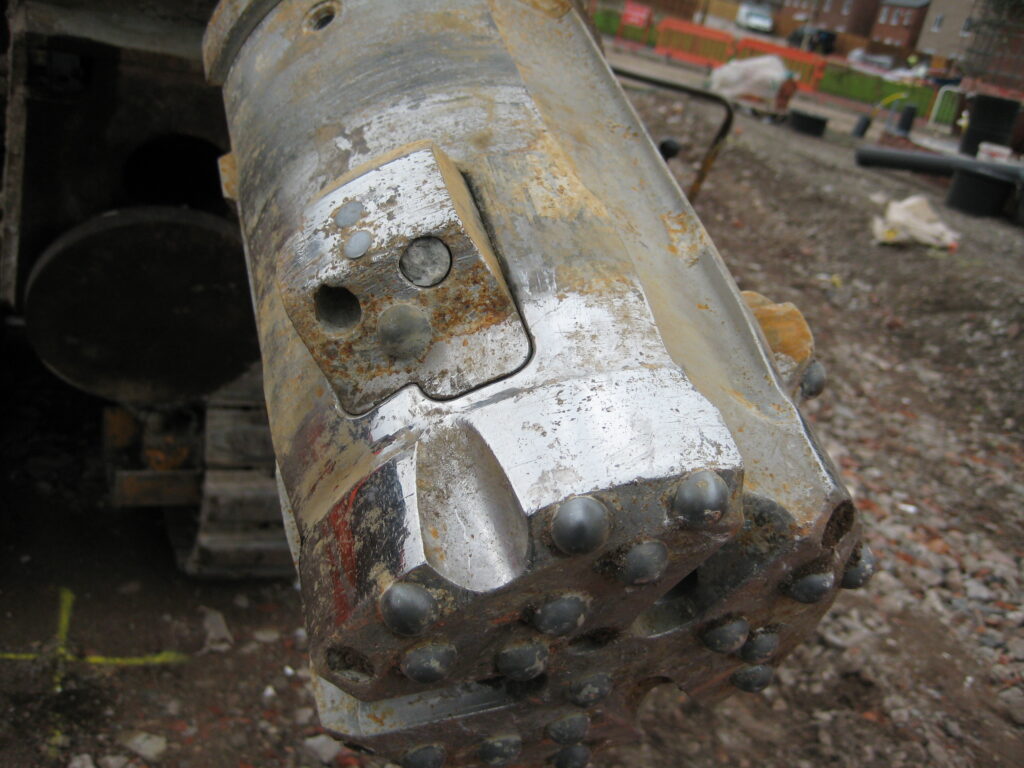
The steel casings are delivered to site in typical section lengths of between 2.0m and 4.0m, depending on the rig being used for installation. The first casing will have a steel ring welded to the bottom known as a shoe. This creates a trim inside the casing for the shoulder of the overburden system to impact upon and progress the casing. Although many overburden systems are available, they typically consist of an eccentric reamer which creates a bore of slightly greater diameter in front of the casing. As the casing is progressed into the ground, air is used to flush the cuttings back up through the casing to the surface. Additional casings are welded onto the starter casing as necessary to reach the rockhead. Upon the rock head being encountered the drill string is reversed slightly causing the eccentric reamer to close.
The drill string can now be removed from the casing to leave an open casing from piling level to rock head. Often, the purpose of this casing is simply to support the overburden ground and allow an open hole rock socket to formed. The rock socket is completed using a smaller diameter down the hole (DTH) hammer. Once again air is used to flush the arising up the casing to the ground surface. Upon completion of the pre-determined socket length, the drill string is again removed, and concrete or grout is used to fill both the socket and casing. Reinforcement is placed into the pile to complete the process.
For a fuller explanation of how ODEX piling works step by step, see our guide to what ODEX piling is.
Talk to us about ODEX Piles
Use the form underneath to speak to our ODEX piles experts.
Reinforced Concrete and Underpinning
In addition to piling, we undertake all types of reinforced concrete works such as ground beams, floor slabs and pile caps. We can also provide costs for setting out, excavation works, piling attendances and spoil removal.
We design and install a range of underpinning systems including traditional underpinning, cantilever beams, knuckle piles and internal piled rafts.
EXCELLENTTrustindex verifies that the original source of the review is Google. Dawsons were excellent on our complex project in Macclesfield. Site conditions were very tight with multiple trades in a small area inside a building. Oliver managed the project to make sure it ran smoothly. Also sorted out the changes to the design overnight to keep the job on track. Highly recommended.Posted on GoogleTrustindex verifies that the original source of the review is Google. Thank you for your work Oliver & team. I didn’t have a clue when it comes to piling, I kept asking for advice before the work commenced and all questions were answered, I had two quotes, Oliver was not only cheaper but made me feel more comfortable - and SOCOTEC building control passed it all through without a problem. ThanksPosted on GoogleTrustindex verifies that the original source of the review is Google. Dawsons have just completed my job in Wigan. Professional throughout, quality workmanship and high health and safety standards on site. Would highly recommend.Posted on GoogleTrustindex verifies that the original source of the review is Google. High standard of service! Oliver was extremely accommodating when I had project delays on my house extension. Would recommend these guys to anyone needed foundation works. Thank you again OliverPosted on GoogleTrustindex verifies that the original source of the review is Google. Dawson foundations very professional brilliant workmanship foundations up to an NHBC Standard wouldn’t have any problem Employing again for upcoming projectPosted on GoogleTrustindex verifies that the original source of the review is Google. Oliver and team helped my company out on a challenging project where we needed to use Odex piling. Oliver designed the appropriate pile and his team come in and installed. Highly recommended and will definitely use again.Verified by TrustindexTrustindex verified badge is the Universal Symbol of Trust. Only the greatest companies can get the verified badge who has a review score above 4.5, based on customer reviews over the past 12 months. Read more
What sets us apart
Specialist Foundation Engineering Across Scotland & the UK
At Dawson Foundation Engineering, we focus exclusively on piling and ground engineering solutions. From constrained residential sites to large commercial developments, our team delivers engineered foundation systems designed around real ground conditions — not assumptions.
How did it begin?
